> For the complete documentation index, see [llms.txt](https://www.mlcompendium.com/llms.txt). Markdown versions of documentation pages are available by appending `.md` to page URLs; this page is available as [Markdown](https://www.mlcompendium.com/ai-engineering/development-concepts.md).
# Development Concepts
ML code still has to be software, and software has names for the shapes that keep it maintainable. The page starts with design patterns, the catalogue of those shapes, and then moves to dependency injection and SOLID, the object-oriented rules underneath them.
## Patterns
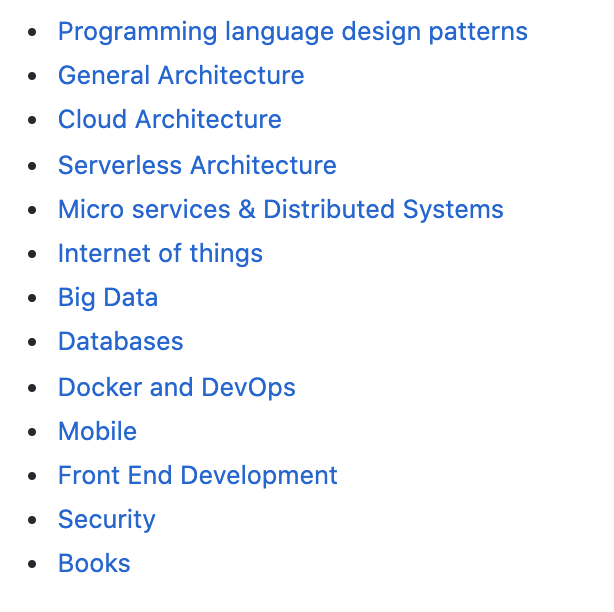
Before any rule, it helps to see the patterns side by side. [Software and architectural design patterns](https://github.com/DovAmir/awesome-design-patterns) is DovAmir's curated list of software and architecture related design patterns, and the figure below is taken from it.
DovAmir
## Programming concepts
With the patterns named, the next question is why they are built the way they are, and dependency injection is the clearest example. [Dependency injection](https://www.freecodecamp.org/news/a-quick-intro-to-dependency-injection-what-it-is-and-when-to-use-it-7578c84fa88f/) is Bhavya Karia's quick intro: one object supplies the dependencies, the services, of another. It is based on [SOLID](https://scotch.io/bar-talk/s-o-l-i-d-the-first-five-principles-of-object-oriented-design#toc-single-responsibility-principle): the class should do one thing, so we are letting other classes create 3rd party/class objects for us instead of doing it internally, either by init passing or by injecting in runtime.
That single-responsibility rule is only the first letter. [SOLID](https://scotch.io/bar-talk/s-o-l-i-d-the-first-five-principles-of-object-oriented-design#toc-single-responsibility-principle) — the five principles of object oriented design, explained as the way to write cleaner, scalable, and maintainable code.
---
# Agent Instructions
This documentation is published with GitBook. GitBook is the documentation platform designed so that both humans and AI agents can read, navigate, and reason over technical content effectively. Learn more at gitbook.com.
## Querying This Documentation
If you need additional information that is not directly available in this page, you can query the documentation by asking a question.
Perform an HTTP GET request on the following URL with the `ask` and `goal` query parameters:
```
GET https://www.mlcompendium.com/ai-engineering/development-concepts.md?ask=&goal=
```
`ask` is the immediate question: it should be specific, self-contained, and written in natural language.
`goal` is what the user is ultimately trying to achieve, the reason they need the answer. Sharing it helps GitBook give you a better, more relevant answer. A goal is most helpful when it describes the outcome the user wants rather than restating the question. For example, with `ask=how do I create an API token`, a goal like `automate deployments from our CI pipeline` lets GitBook tailor the answer to that use case.
The response will contain a direct answer to the question and relevant excerpts and sources from the documentation.
Use this mechanism when the answer is not explicitly present in the current page, you need clarification or additional context, or you want to retrieve related documentation sections.