> For the complete documentation index, see [llms.txt](https://www.mlcompendium.com/llms.txt). Markdown versions of documentation pages are available by appending `.md` to page URLs; this page is available as [Markdown](https://www.mlcompendium.com/data/engineering-intro/data-governance.md).
# Data Governance
Someone has to own who may change the data and what “good” means across teams. The page starts with definitions of data governance, then moves to guides for building it in Snowflake and a thorough survey article, and ends with concrete action items and starting steps.
Governance decides the rules that the fabric enforces and the lineage records. The same notes are in [Data Fabric](/data/engineering-intro/database-architecture-and-modeling.md#data-fabric) and [Data Lineage](/data/engineering-intro/data-lineage.md).
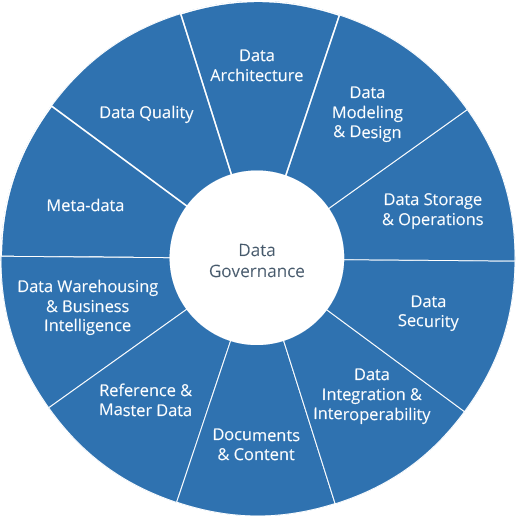
The first definition is the [Definition](https://www.cleverrepublic.com/what-is/data-governance/) page from Clever Republic, a consultancy that implements data governance, with the definition taken from DAMA. The DAMA image it once pointed to no longer opens and is kept at the end of the page. [What is](https://www.imperva.com/learn/data-security/data-governance/) is Imperva's shorter version: data governance is a set of practices and processes for managing important data across an organization, with frameworks and tools to help.
From definition to build: How to build [part 1](https://www.phdata.io/blog/snowflake-data-governance/) is Nick Goble on why data governance controls are critical for consistent, dependable data and how to set them up in Snowflake. [part 2](https://www.phdata.io/blog/snowflake-data-governance-2/) continues with access controls, arguing that Snowflake needs a defined information architecture, a process for providing access, and a group responsible for managing those rules and patterns. For the whole field in one place, [a very thorough article](https://bi-survey.com/data-governance/) is the BARC survey piece, and the figure below comes from it.
a very thorough article
Reading is not starting, so the page ends with what to do first. The [action items](https://data.wisc.edu/data-governance/) are the data governance page of UW–Madison's Data, Academic Planning & Institutional Research office. [8 steps to start your data governance program](https://www.analytics8.com/blog/8-steps-to-start-your-data-governance-program/) is Jenna O'Jea's step-by-step guide to a data governance strategy fitted to the organization, with its components and benefits.
## Deprecated links
{% hint style="warning" %}
These links and images no longer work. The original wording is kept here. A same-resource copy, when one was checked, is used above.
{% endhint %}
* DAMA. This address no longer opens:
---
# Agent Instructions
This documentation is published with GitBook. GitBook is the documentation platform designed so that both humans and AI agents can read, navigate, and reason over technical content effectively. Learn more at gitbook.com.
## Querying This Documentation
If you need additional information that is not directly available in this page, you can query the documentation by asking a question.
Perform an HTTP GET request on the following URL with the `ask` and `goal` query parameters:
```
GET https://www.mlcompendium.com/data/engineering-intro/data-governance.md?ask=&goal=
```
`ask` is the immediate question: it should be specific, self-contained, and written in natural language.
`goal` is what the user is ultimately trying to achieve, the reason they need the answer. Sharing it helps GitBook give you a better, more relevant answer. A goal is most helpful when it describes the outcome the user wants rather than restating the question. For example, with `ask=how do I create an API token`, a goal like `automate deployments from our CI pipeline` lets GitBook tailor the answer to that use case.
The response will contain a direct answer to the question and relevant excerpts and sources from the documentation.
Use this mechanism when the answer is not explicitly present in the current page, you need clarification or additional context, or you want to retrieve related documentation sections.