> For the complete documentation index, see [llms.txt](https://www.mlcompendium.com/llms.txt). Markdown versions of documentation pages are available by appending `.md` to page URLs; this page is available as [Markdown](https://www.mlcompendium.com/deep-learning/transformers.md).
# Transformers
The Transformer replaced recurrence with attention, and a whole family of variants grew from it. This page starts with Jay Alammar's illustrated walkthroughs and the annotated notes, then moves to the long-context surveys and the transformer family, and ends with the sparse and memory-layer work.
The entry point for TRANSFORMERS is visual. [Jay alammar on transformers](http://jalammar.github.io/illustrated-transformer/) is The Illustrated Transformer (amazing), featured in courses at Stanford, Harvard, and MIT. From the architecture to the pretrained models, [J.A on Bert Elmo](http://jalammar.github.io/illustrated-bert/) is The Illustrated BERT, ELMo, and co. (How NLP Cracked Transfer Learning), which marks 2018 as an inflection point for models handling text. [Jay alammar on a visual guide of bert for the first time](http://jalammar.github.io/a-visual-guide-to-using-bert-for-the-first-time/) is A Visual Guide to Using BERT for the First Time, set against BERT becoming a major force behind Google Search. [J.A on GPT2](http://jalammar.github.io/illustrated-bert/) points to the same Illustrated BERT, ELMo, and co. post.
Speed and long inputs are the next problems, which is why Super fast transformers and A survey of long term context in transformers. come next.
A survey of long-term context in transformers.
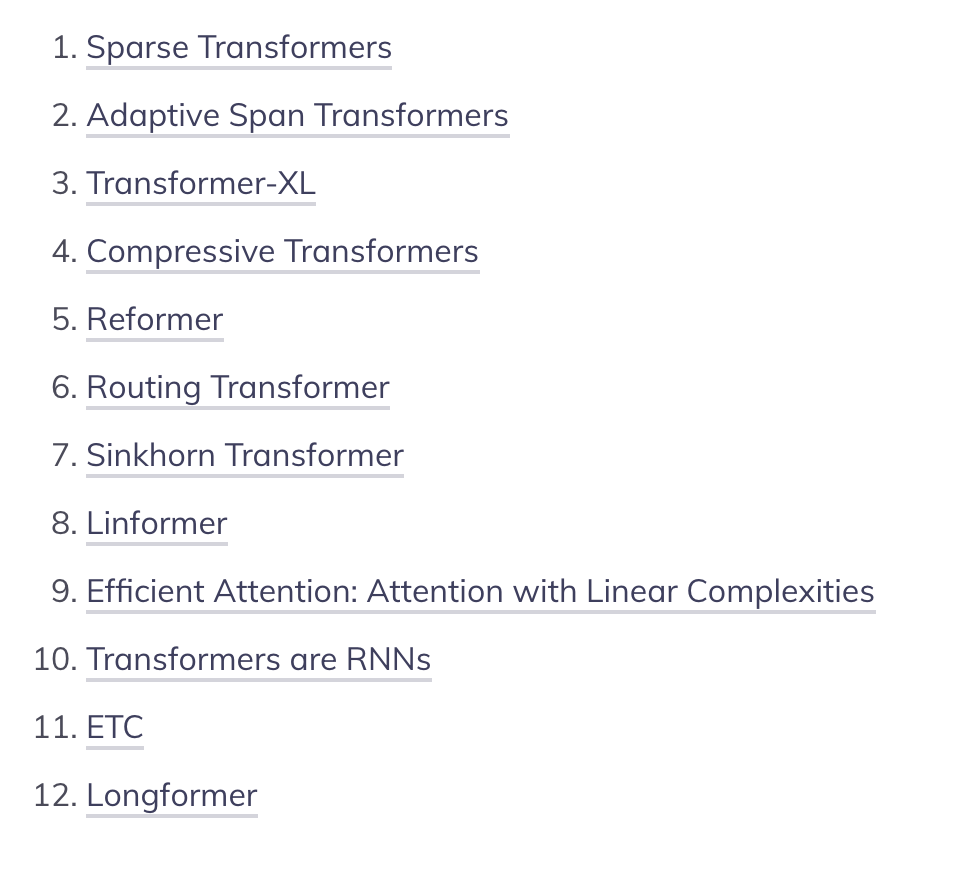
The figure is from that long-term context survey. The variants themselves are mapped in [Lilian Wang on the transformer family](https://lilianweng.github.io/lil-log/2020/04/07/the-transformer-family.html), The Transformer Family on Lil'Log.
The transformer family.
The family also splits into encoders and decoders. Hugging face [encoders decoders in transformers for seq2seq](https://medium.com/huggingface/encoder-decoders-in-transformers-a-hybrid-pre-trained-architecture-for-seq2seq-af4d7bf14bb8) is their post on a hybrid pre-trained encoder-decoder architecture for seq2seq, built on their Transformers library, which implements many state-of-the-art transformer models behind an API compatible with both PyTorch and Tensorflow. To read the original model as code, [The annotated transformer](http://nlp.seas.harvard.edu/2018/04/03/attention.html) is The Annotated Transformer.
Scaling further changes the layers themselves. [Large memory layers with product keys](https://arxiv.org/abs/1907.05242) - This memory layer allows us to tackle very large scale language modeling tasks. In our experiments we consider a dataset with up to 30 billion words, and we plug our memory layer in a state-of-the-art transformer-based architecture. In particular, we found that a memory augmented model with only 12 layers outperforms a baseline transformer model with 24 layers, while being twice faster at inference time.
Sparsity is the other lever. [Adaptive sparse transformers](https://arxiv.org/abs/1909.00015) - This sparsity is accomplished by replacing softmax with
α-entmax: a differentiable generalization of softmax that allows low-scoring words to receive precisely zero weight. Moreover, we derive a method to automatically learn the
α parameter -- which controls the shape and sparsity of
α-entmax -- allowing attention heads to choose between focused or spread-out behavior. Our adaptively sparse Transformer improves interpretability and head diversity when compared to softmax Transformers on machine translation datasets.
---
# Agent Instructions
This documentation is published with GitBook. GitBook is the documentation platform designed so that both humans and AI agents can read, navigate, and reason over technical content effectively. Learn more at gitbook.com.
## Querying This Documentation
If you need additional information that is not directly available in this page, you can query the documentation by asking a question.
Perform an HTTP GET request on the following URL with the `ask` and `goal` query parameters:
```
GET https://www.mlcompendium.com/deep-learning/transformers.md?ask=&goal=
```
`ask` is the immediate question: it should be specific, self-contained, and written in natural language.
`goal` is what the user is ultimately trying to achieve, the reason they need the answer. Sharing it helps GitBook give you a better, more relevant answer. A goal is most helpful when it describes the outcome the user wants rather than restating the question. For example, with `ask=how do I create an API token`, a goal like `automate deployments from our CI pipeline` lets GitBook tailor the answer to that use case.
The response will contain a direct answer to the question and relevant excerpts and sources from the documentation.
Use this mechanism when the answer is not explicitly present in the current page, you need clarification or additional context, or you want to retrieve related documentation sections.