> For the complete documentation index, see [llms.txt](https://www.mlcompendium.com/llms.txt). Markdown versions of documentation pages are available by appending `.md` to page URLs; this page is available as [Markdown](https://www.mlcompendium.com/natural-language-processing-nlp/language-detection-identification-generation-nld-nli-nlg.md).
# Language Detection Identification Generation (NLD, NLI, NLG)
Before any other language task, a system has to know which language it is reading, and then it may have to generate or translate text in that language. The page goes in that order: language detection tools and how they compare, word-based neural language models, character-based versus word-based generation, and finally translation, its BLEU metric, and named entity transliteration.
## LANGUAGE DETECTION / IDENTIFICATION
Language identification looks solved until you compare the tools on short texts and rare languages, so this section sets CLD, fastText, and the cloud APIs side by side.
The same notes are in [Language detection](/natural-language-processing-nlp/foundation-nlp.md#language-detection).
The cloud providers are the first comparison. [A qualitative comparison of google, azure, amazon, ibm LD LI](https://medium.com/activewizards-machine-learning-company/comparison-of-the-most-useful-text-processing-apis-e4b4c1e6626a) is Igor Bobriakov's comparison of text processing APIs, written for the choice between building the whole system from scratch, which is time and resource consuming, and using what big companies already offer.
The open-source baseline is Google's Compact Language Detector. [CLD2](https://github.com/CLD2Owners/cld2/tree/master/docs) is the docs folder of Compact Language Detector 2, [CLD3](https://github.com/google/cld3) is Google's successor repository, and [PYCLD](https://github.com/aboSamoor/pycld2) is the Python binding. Polyglot's language detection documentation is a second wrapper: 2 [POLYGLOT wraps CLD](https://polyglot.readthedocs.io/en/latest/Detection.html). To see how CLD holds up, [alex ott cld stats](https://gist.github.com/alexott/dd43fa8d1db4b8202d55c6325b2c69c2) is the gist of data from a language detection evaluation, and [cld comparison vs tika langid](http://blog.mikemccandless.com/2011/10/accuracy-and-performance-of-googles.html) is Mike McCandless testing the accuracy and performance of Google's Compact Language Detector against two other packages.
fastText is the main challenger. [Fast text LI](https://fasttext.cc/blog/2017/10/02/blog-post.html) is the fastText post on fast and accurate language identification, and the [facebook post](https://www.facebook.com/groups/1174547215919768/permalink/1702123316495486/?comment_id=1704414996266318\&reply_comment_id=1705159672858517\¬if_id=1507280476710677\¬if_t=group_comment) is Rafael Oliveira's comment in the discussion around it, which the evaluation below refers to. OPENNLP is the fourth detector in that evaluation.
The cloud APIs each document their own detector. [Google detect language](https://cloud.google.com/translate/docs/detecting-language) shows how to detect language using the Advanced and Basic APIs of Cloud Translation, and the github code for the [v3beta](https://cloud.google.com/translate/docs/detecting-language-v3) is the same guide for the newer API; the code sample itself is kept at the end of the page. [Microsoft azure LD,](https://docs.microsoft.com/en-us/azure/cognitive-services/text-analytics/how-tos/text-analytics-how-to-language-detection) is the overview of language detection in Azure Language, which returns language codes for the language a text is written in. [Ibm watson](https://cloud.ibm.com/apidocs/language-translator) is the Language Translator API docs, where IBM announces the deprecation of the Watson Language Translator service in all regions. IBM's second page, [2](https://www.ibm.com/support/knowledgecenter/SS8NLW_11.0.1/com.ibm.swg.im.infosphere.dataexpl.engine.doc/c_vse_language_detection.html), now answers that the page cannot be displayed. [Amazon,](https://docs.aws.amazon.com/comprehend/latest/dg/how-languages.html) is the Amazon Comprehend guide to determining the dominant language of a text, and [2](https://aws.amazon.com/comprehend/) is the Comprehend product page, the NLP service that uses machine learning to uncover information in unstructured text.
Beyond Google and the clouds, a few specialist detectors claim more. [Lingua - most accurate for java… doesn't seem like its accurate enough](https://github.com/pemistahl/lingua) is the library that calls itself the most accurate natural language detection library for Java and the JVM, for long and short text alike. [LD with infinity gram 99.1 on a lot of data a benchmark for this 2012 method](https://shuyo.wordpress.com/2012/02/21/language-detection-for-twitter-with-99-1-accuracy/) is Shuyo's post on language detection for twitter with 99.1% accuracy, and [LD with infinity gram](https://github.com/shuyo/ldig) is its code, ldig. [WiLI dataset for LD, comparison of CLD vs others ](https://arxiv.org/pdf/1801.07779.pdf)is the WiLI benchmark dataset for written language identification.
The most detailed head-to-head is Alex Ott's. [Comparison of CLD vs FT vs OPEN NLP](http://alexott.blogspot.com/2017/10/evaluating-fasttexts-models-for.html) - beware based on 200 samples per language!! The conclusions are quoted from that post:
Full results for every language that I tested are in table at the end of blog post & on [Github](https://gist.github.com/alexott/dd43fa8d1db4b8202d55c6325b2c69c2). From them I can make following conclusions:
* all detectors are equally good on some languages, such as, Japanese, Chinese, Vietnamese, Greek, Arabic, Farsi, Georgian, etc. - for them the accuracy of detection is between 98 & 100%;
* CLD is much better in detection of "rare" languages, especially for languages, that are similar to more frequently used - Afrikaans vs Dutch, Azerbaijani vs. Turkish, Malay vs. Indonesian, Nepali vs. Hindi, Russian vs Bulgarian, etc. (it could be result of imbalance of training data - I need to check the source dataset);
* for "major" languages not mentioned above (English, French, German, Spanish, Portuguese, Dutch) the fastText results are much better than CLD's, and in many cases lingid.py's & OpenNLP's;
* for many languages results for "compressed" fastText model are slightly worse than results from "full" model (mostly only by 1-2%, but could be higher, like for Kazakh when difference is 33%), but there are languages where the situation is different - results for compressed are slight better than for full (for example, for German or Dutch);
OpenNLP has many misclassifications for Cyrillic languages - Russian/Ukrainian, ...
Rafael Oliveira [posted on FB](https://www.facebook.com/groups/1174547215919768/permalink/1702123316495486/?comment_id=1704414996266318\&reply_comment_id=1705159672858517\¬if_id=1507280476710677\¬if_t=group_comment) a simple diagram that shows what languages are detected better by CLD & what is better handled by fastText
Here are some additional notes about differences in behavior of detectors that I observe during analyzing results:
* fastText is more reliable than CLD on the short texts;
* fastText models & langid.py detect language as Hebrew instead of Jewish as in CLD. Similarly, CLD uses 'in' for Indonesian language instead of standard 'id' used by fastText & langid.py;
* fastText distinguish between Cyrillic- & Latin-based versions of Serbian;
* CLD tends to incorporate geographical & person's names into detection results - for example, blog post in German about travel to Iceland is detected as Icelandic, while fastText detects it as German;
* In extended detection mode CLD tends to select more rare language, like, Galician or Catalan over Spanish, Serbian instead of Russian, etc.
* OpenNLP isn't very good in detection for short texts.
The models released by fastText development team provides very good alternative to existing language detection tools, like, Google's CLD & langid.py - for most of "popular" languages, these models provides higher detection accuracy comparing to other tools, combined with high speed of detection (drawback of langid.py). Even using "compressed" model it's possible to reach good detection accuracy. Although for some less frequently used languages, CLD & langid.py may show better results.
Performance-wise, the langid.py is much slower than both CLD & fastText. On average, CLD requires 0.5-1 ms to perform language detection. For fastText & langid.py I don't have precise numbers yet, only approximates based on speed of execution of corresponding programs.
The figure below is that CLD versus fastText comparison.
CLD versus fastText language detection comparison.
GIT:
If none of these fits, the code to start from is ldig, [LD with infinity gram](https://github.com/shuyo/ldig), the Language Detection with Infinity-gram repository.
Articles:
Training your own detector is also quick. [Medium on training LI models](https://medium.com/data-science/how-i-trained-a-language-detection-ai-in-20-minutes-with-a-97-accuracy-fdeca0fb7724) is Aaron Edell's step-by-step guide to building a language detection model that reached 97% accuracy in under 20 minutes.
Papers:
The papers compare the approaches formally. [A comparison of lang ident approaches](https://link.springer.com/chapter/10.1007/978-3-642-12275-0_59) is a Springer chapter. [lI on code switch social media](https://www.aclweb.org/anthology/W18-3206) is Language Identification and Analysis of Code-Switched Social Media Text by Deepthi Mave, Suraj Maharjan, and Thamar Solorio, from the Third Workshop on Computational Approaches to Linguistic Code-Switching, 2018. [Comparing LI methods, has 6 big languages](http://citeseerx.ist.psu.edu/viewdoc/download?doi=10.1.1.149.630\&rep=rep1\&type=pdf) and [Comparing LI techniques](https://dbs.cs.uni-duesseldorf.de/lehre/bmarbeit/barbeiten/ba_panich.pdf), a 2015 bachelor's thesis from Düsseldorf, are two more comparisons. [Radim rehurek LI on the web extending the dictionary](https://radimrehurek.com/cicling09.pdf) was the CICLing 2009 paper; the address now opens a PII Tools page instead. [Comparative study of LI methods](https://pdfs.semanticscholar.org/c422/3cc3765a1ac2e085b420e771d8022e6c244f.pdf) is A Comparative Study on Language Identification Methods, and [2](https://www.semanticscholar.org/paper/A-Comparative-Study-on-Language-Identification-Grothe-Luca/3f47b38b434f614d0cbf9af94cb4d74aa2bfe759) is its Semantic Scholar page.
## Neural Language Models
Once the language is known, the next step is a model of that language, and the simplest neural version predicts the next word. [Mastery on Word-based ](https://machinelearningmastery.com/develop-word-based-neural-language-models-python-keras/)is MachineLearningMastery on developing word-based neural language models in Python with Keras.
## NEURAL LANGUAGE GENERATION
A language model that predicts the next unit can also generate text, and the main design choice is whether that unit is a character or a word.
The same notes are in [Large Language Models (LLMs)](/generative-ai/large-language-models-llms.md).
[Using RNN](https://www.aclweb.org/anthology/C16-1103) is Natural Language Generation through Character-based RNNs with Finite-state Prior Knowledge by Raghav Goyal, Marc Dymetman, and Eric Gaussier at COLING 2016. [Using language modeling](https://medium.com/@shivambansal36/language-modelling-text-generation-using-lstms-deep-learning-for-nlp-ed36b224b275) is Shivam Bansal on language modelling and text generation with LSTMs, the recurrent networks that make text generation feasible.
The character-or-word choice has a clear answer on StackExchange: [Word based vs char based](https://datascience.stackexchange.com/questions/13138/what-is-the-difference-between-word-based-and-char-based-text-generation-rnns) - Word-based LMs display higher accuracy and lower computational cost than char-based LMs. However, char-based RNN LMs better model languages with a rich morphology such as Finish, Turkish, Russian etc. Using word-based RNN LMs to model such languages is difficult if possible at all and is not advised. Char-based RNN LMs can mimic grammatically correct sequences for a wide range of languages, require bigger hidden layer and computationally more expensive while word-based RNN LMs train faster and generate more coherent texts and yet even these generated texts are far from making actual sense.
For the character side, [mediu m on Char based with code, leads to better grammer](https://medium.com/data-science/besides-word-embedding-why-you-need-to-know-character-embedding-6096a34a3b10) asks why you need character embedding beside the word embedding Tomas Mikolov introduced in 2013: instead of aggregating from word to document, aggregate from character to word. To try both, [Git, keras language models, char level word level and sentence using VAE](https://github.com/pbloem/language-models) has Keras implementations of a character-level RNN, a word-level RNN, and the Sentence VAE of Bowman, Vilnis et al 2016.
## LANGUAGE TRANSLATION
Generation in one language leads to generation from one language into another, and translation brings its own metric, BLEU, and its own edge case, transliterating names.
The same notes are in [Augmentation](/natural-language-processing-nlp/augmentation.md) and [Metrics](/generative-ai/large-language-models-llms.md#metrics).
The field overview comes first: [State of the art methods for neural machine translation](https://www.topbots.com/ai-nlp-research-neural-machine-translation/) - a review of papers. For many languages at once, LASER: [Zero shot multi lang-translation by facebook](https://code.fb.com/ai-research/laser-multilingual-sentence-embeddings/) is the toolkit that performs zero-shot cross-lingual transfer with more than 90 languages and is now open source, and its [github](https://github.com/facebookresearch/LASER) is Language-Agnostic SEntence Representations.
The same notes are in [Multi Language](/natural-language-processing-nlp/multi-language.md).
[How to use laser on medium](https://medium.com/the-artificial-impostor/multilingual-similarity-search-using-pretrained-bidirectional-lstm-encoder-e34fac5958b0) is multilingual similarity search with that pretrained bidirectional LSTM encoder from Facebook. Beyond translation, Stanford coreNLP language POS/NER/DEP PARSE etc for [53 languages](https://www.analyticsvidhya.com/blog/2019/02/stanfordnlp-nlp-library-python) covers the rest of the pipeline. [Using embedding spaces](https://rare-technologies.com/translation-matrix-in-gensim-python/) was the gensim translation matrix post on the RARE Technologies site; the address now opens a PII Tools page instead.
A translation system needs a score, and BLEU is the one everyone reports. [The risk of using bleu](https://medium.com/data-science/evaluating-text-output-in-nlp-bleu-at-your-own-risk-e8609665a213) is Rachael Tatman on evaluating systems whose output is text, the sequence to sequence or string transduction problems. Really good: [BLUE - what is it, how it is calculated?](https://slator.com/technology/how-bleu-measures-translation-and-why-it-matters/) is Slator on how BLEU measures translation and why it matters, starting from Sundar Pichai presenting Google Translate's move from 3.694 (phrase-based) to 4.263 (neural), with human quality at 4.636. The notes from that article follow.
“\[BLEU] looks at the presence or absence of particular words, as well as the ordering and the degree of distortion—how much they actually are separated in the output.”
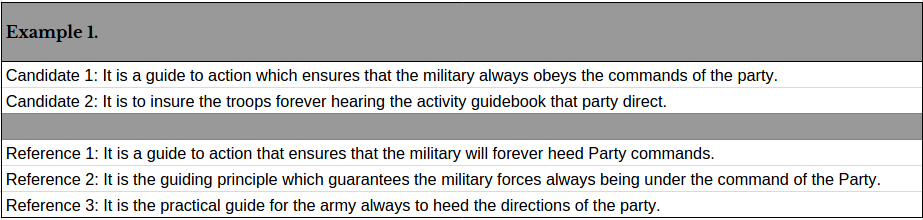
BLEU’s evaluation system requires two inputs: (i) a numerical translation closeness metric, which is then assigned and measured against (ii) a corpus of human reference translations.
BLEU averages out various metrics using an [n-gram method](https://en.wikipedia.org/wiki/N-gram), a probabilistic language model often used in computational linguistics.
BLEU sample
The result is typically measured on a 0 to 1 scale, with 1 as the hypothetical “perfect” translation. Since the human reference, against which MT is measured, is always made up of multiple translations, even a human translation would not score a 1, however. Sometimes the score is expressed as multiplied by 100 or, as in the case of Google mentioned above, by 10.
a BLEU score offers more of an intuitive rather than an absolute meaning and is best used for relative judgments: “If we get a BLEU score of 35 (out of 100), it seems okay, but it actually has no correlation to the quality of the output in any meaningful sense. If it’s less than 15, we can probably safely say it’s very bad. If it’s greater than 60, we probably have some mistake in our testing! So it will generally fall in there.”
“Typically, if you have multiple \[human translation] references, the BLEU score tends to be higher. So if you hear a very large BLEU score—someone gives you a value that seems very high—you can ask them if there are multiple references being used; because, then, that is the reason that the score is actually higher.”
Because the score depends on those settings, reported BLEU numbers are hard to compare. The [General talk](https://slator.com/technology/google-facebook-amazon-neural-machine-translation-just-had-its-busiest-month-ever/) about FAMG (fb, ama, micro, goog) and research direction atm, including some info about BLUE scores and the comparison issues with reports of BLUE (boils down to diff unmentioned parameters). One proposed solution is [sacreBLUE](https://arxiv.org/pdf/1804.08771.pdf) One proposed solution pip install sacreblue
Named entity language transliteration
Names are the part of translation that should not be translated at all, only written in another script. The [Paper](https://arxiv.org/pdf/1808.02563.pdf) is Design Challenges in Named Entity Transliteration. The Amazon Alexa [blog post](https://developer.amazon.com/blogs/alexa/post/ec66406c-094c-4dbc-8e9f-01050b27d43d/automatic-transliteration-can-help-alexa-find-data-across-language-barriers) is on how automatic transliteration can help Alexa find data across language barriers. The code and data from the experiments cover English russian, hebrew, arabic, japanese, with data set and code on [github](https://github.com/steveash/NETransliteration-COLING2018).
Two Towards Data Science copies of notes above keep their original addresses. The copy of Medium on training LI models is ; that address now opens a different article, Clara Chong's How LLMs Work. The copy of The risk of using bleu is .
## Deprecated links
{% hint style="warning" %}
These links and images no longer work. The original wording is kept here. A same-resource copy, when one was checked, is used above.
{% endhint %}
* mediu m on Char based with code, leads to better grammer This address no longer opens:
* github code This address no longer opens:
* 2 This address no longer opens:
---
# Agent Instructions
This documentation is published with GitBook. GitBook is the documentation platform designed so that both humans and AI agents can read, navigate, and reason over technical content effectively. Learn more at gitbook.com.
## Querying This Documentation
If you need additional information that is not directly available in this page, you can query the documentation by asking a question.
Perform an HTTP GET request on the following URL with the `ask` and `goal` query parameters:
```
GET https://www.mlcompendium.com/natural-language-processing-nlp/language-detection-identification-generation-nld-nli-nlg.md?ask=&goal=
```
`ask` is the immediate question: it should be specific, self-contained, and written in natural language.
`goal` is what the user is ultimately trying to achieve, the reason they need the answer. Sharing it helps GitBook give you a better, more relevant answer. A goal is most helpful when it describes the outcome the user wants rather than restating the question. For example, with `ask=how do I create an API token`, a goal like `automate deployments from our CI pipeline` lets GitBook tailor the answer to that use case.
The response will contain a direct answer to the question and relevant excerpts and sources from the documentation.
Use this mechanism when the answer is not explicitly present in the current page, you need clarification or additional context, or you want to retrieve related documentation sections.