> For the complete documentation index, see [llms.txt](https://www.mlcompendium.com/llms.txt). Markdown versions of documentation pages are available by appending `.md` to page URLs; this page is available as [Markdown](https://www.mlcompendium.com/natural-language-processing-nlp/neural-nlp.md).
# Neural NLP
Neural networks read text either as a whole window at once or as a sequence in and a sequence out. The page covers the first with convolutional nets for text, then the second with encoder-decoder sequence-to-sequence models, teacher forcing, and the copying mechanism.
The same notes are in [Deep Learning for NLP](/deep-learning/deep-neural-nets.md#deep-learning-for-nlp).
## CONVOLUTION NEURAL NETS (CNN)
Convolutions are the fast way to let a network see a whole sentence. The same notes are in [CONVOLUTIONAL NEURAL NET](/deep-learning/convolutional-nets.md#convolutional-neural-net).
[Cnn for text](https://medium.com/@TalPerry/convolutional-methods-for-text-d5260fd5675f) is tal perry's Convolutional Methods for Text: RNNs work great for text but convolutions can do it faster, any part of a sentence can influence the semantics of a word so the network should see the entire input at once, and getting that big a receptive field can make gradients vanish. A note on 1D CNN using KERAS for time sequences used to sit here; that address no longer opens and is kept at the end of the page.
## SEQ2SEQ SEQUENCE TO SEQUENCE
When the output is also a sequence, such as a translation, the network becomes an encoder and a decoder, and the training trick that makes it work is teacher forcing.
The same notes are in [Attention](/deep-learning/attention.md), [Decoding Algorithms For NLP](/natural-language-processing-nlp/decoding-algorithms-for-nlp.md), and [Recurrent Neural Net (RNN)](/deep-learning/recurrent-nets.md#recurrent-neural-net-rnn).
The starting point is the [Keras blog](https://blog.keras.io/a-ten-minute-introduction-to-sequence-to-sequence-learning-in-keras.html) — char-level, token-using embedding layer, teacher forcing. [Teacher forcing explained](https://medium.com/data-science/what-is-teacher-forcing-3da6217fed1c) is Wanshun Wong's What is Teacher Forcing?. [Same as keras but with token-level](https://medium.com/data-science/machine-translation-with-the-seq2seq-model-different-approaches-f078081aaa37) is Dhruvil Shah on different seq2seq approaches to machine translation, which rarely works as mechanical substitution of words because it needs comprehension of entire sentences. [Medium on char, word, byte-level](https://medium.com/@petepeeradejtanruangporn/experimenting-with-neural-machine-translation-for-thai-1681fd2b375a) is Pete Peeradej Tanruangporn's experiments with neural machine translation for Thai, where better masking and a larger network brought non-word level models to match or almost match word levels.
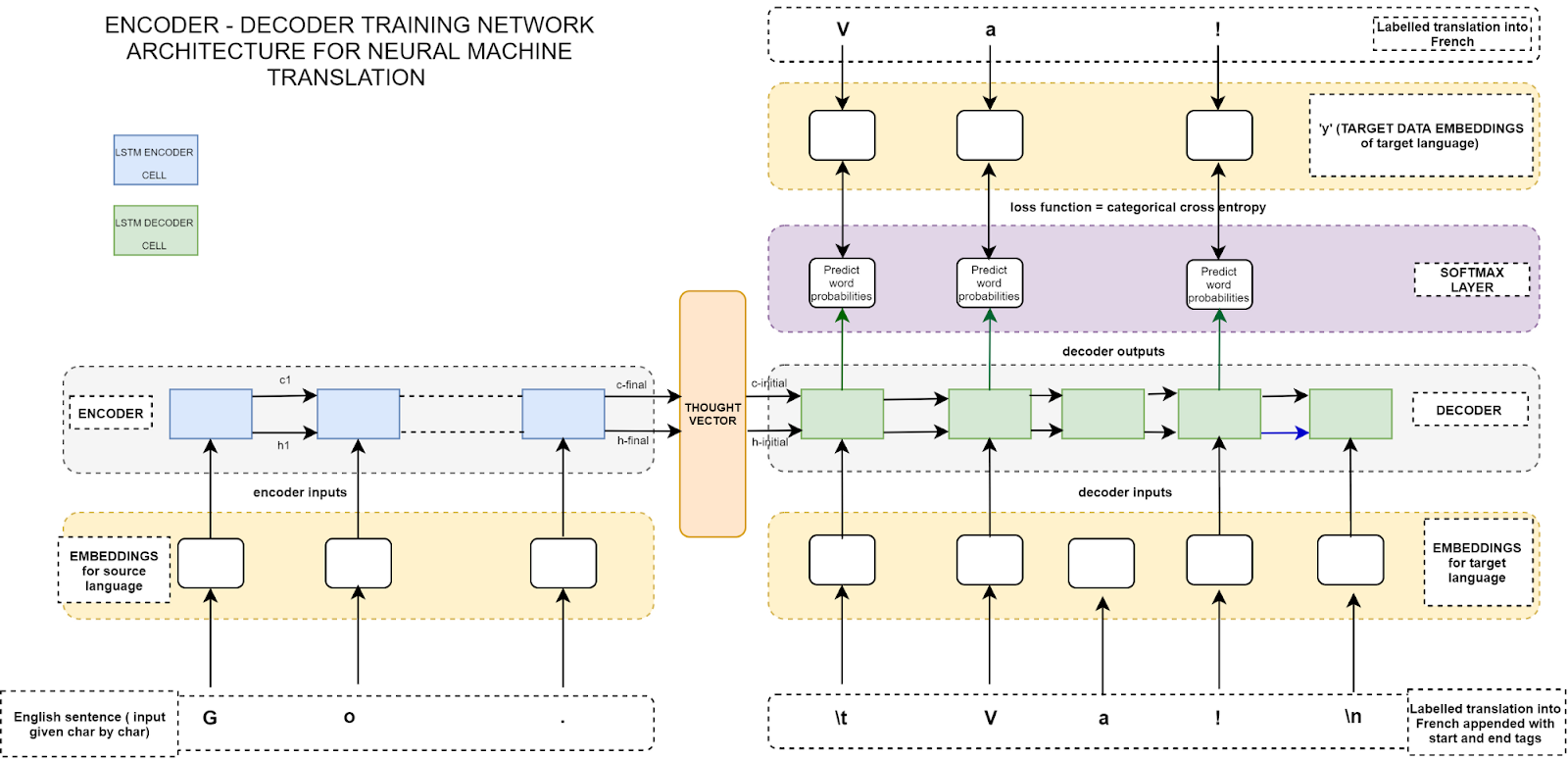
The same encoder-decoder can be built step by step. [Mastery on enc-dec using the keras method](https://machinelearningmastery.com/develop-encoder-decoder-model-sequence-sequence-prediction-keras/) is MachineLearningMastery's encoder-decoder model for sequence-to-sequence prediction in Keras, and on [neural translation](https://machinelearningmastery.com/define-encoder-decoder-sequence-sequence-model-neural-machine-translation-keras/) it is the seq2seq model for neural machine translation. [Machine translation git from eng to jap](https://github.com/samurainote/seq2seq_translate_slackbot/blob/master/seq2seq_translate.py) is the translation script in samurainote's seq2seq\_translate\_slackbot, [another](https://github.com/samurainote/seq2seq_translate_slackbot) is the whole repository, and its [medium](https://medium.com/data-science/how-to-implement-seq2seq-lstm-model-in-keras-shortcutnlp-6f355f3e5639) post explains how to implement the Seq2Seq LSTM model in Keras, the encoder-decoder RNN used for machine interaction and machine translation. The figure below shows that sequence-to-sequence translation setup.
Sequence-to-sequence machine translation.
A plain decoder can only generate from its vocabulary, so names and rare words in the input get lost. [Incorporating Copying Mechanism in Sequence-to-Sequence Learning](https://arxiv.org/abs/1603.06393) — In this paper, we incorporate copying into neural network-based Seq2Seq learning and propose a new model called CopyNet with encoder-decoder structure. CopyNet can nicely integrate the regular way of word generation in the decoder with the new copying mechanism which can choose sub-sequences in the input sequence and put them at proper places in the output sequence.
## Deprecated links
{% hint style="warning" %}
These links and images no longer work. The original wording is kept here. A same-resource copy, when one was checked, is used above.
{% endhint %}
* Teacher forcing explained This address no longer opens:
* Same as keras but with token-level This address no longer opens:
* its medium This address no longer opens:
* 1D CNN using KERAS This address no longer opens:
---
# Agent Instructions
This documentation is published with GitBook. GitBook is the documentation platform designed so that both humans and AI agents can read, navigate, and reason over technical content effectively. Learn more at gitbook.com.
## Querying This Documentation
If you need additional information that is not directly available in this page, you can query the documentation by asking a question.
Perform an HTTP GET request on the following URL with the `ask` and `goal` query parameters:
```
GET https://www.mlcompendium.com/natural-language-processing-nlp/neural-nlp.md?ask=&goal=
```
`ask` is the immediate question: it should be specific, self-contained, and written in natural language.
`goal` is what the user is ultimately trying to achieve, the reason they need the answer. Sharing it helps GitBook give you a better, more relevant answer. A goal is most helpful when it describes the outcome the user wants rather than restating the question. For example, with `ask=how do I create an API token`, a goal like `automate deployments from our CI pipeline` lets GitBook tailor the answer to that use case.
The response will contain a direct answer to the question and relevant excerpts and sources from the documentation.
Use this mechanism when the answer is not explicitly present in the current page, you need clarification or additional context, or you want to retrieve related documentation sections.