> For the complete documentation index, see [llms.txt](https://www.mlcompendium.com/llms.txt). Markdown versions of documentation pages are available by appending `.md` to page URLs; this page is available as [Markdown](https://www.mlcompendium.com/problem-framing/n-shot-learning.md).
# N-Shot Learning
Sometimes each class has only a handful of labeled examples, or none at all. The page defines zero-, one-, and few-shot learning, then shows how zero-shot learning replaces labels with class vectors, and ends with how large language models treat prompts as zero-, one-, and few-shot shots.
The same notes are in [SIAMESE NETWORKS](/deep-learning/deep-neural-nets.md#siamese-networks) and [SIAMESE NETWORKS (one shot)](/deep-learning/siamese-nets.md#siamese-networks-one-shot).
### N-SHOT LEARNING
N-shot learning means training or adapting with only a handful of labeled examples per class. The FloydHub Team's "N-Shot Learning: Learning More with Less Data" asks whether it is possible to use machine learning with small data, and answers yes, covering [Zero shot, one shot, few shot](https://floydhub.github.io/n-shot-learning/).
### ZERO SHOT LEARNING
The extreme case is zero examples: zero-shot learning classifies new classes using side information instead of labeled examples for those classes. [Instead of using class labels](https://www.youtube.com/watch?v=jBnCcr-3bXc), we use some kind of vector representation for the classes, taken from a co-occurrence-after-svd or word2vec. — quite clever. This enables us to figure out if a new unseen class is near one of the known supervised classes. KNN can be used or some other distance-based classifier. Can we use word2vec for similarity measurements of new classes?
The same notes are in [WORD2VEC](/natural-language-processing-nlp/language-embeddings.md#word2vec).
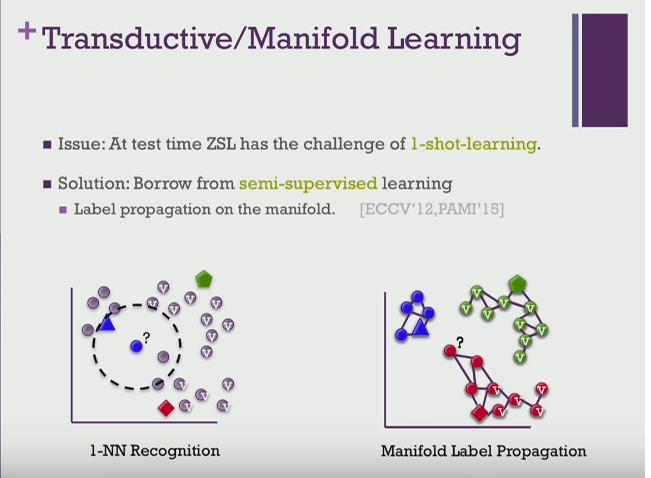
The two figures below come from that video, by Dr. Timothy Hospedales at Yandex. The first shows the class-vector idea.
Image by Dr. Timothy Hospedales, Yandex
Once classes live in a vector space, for classification, we can use nearest neighbour or manifold-based labeling propagation, as the second figure shows.
Image by Dr. Timothy Hospedales, Yandex
Multiple category vectors? Multilabel zero-shot also in the video.
The same idea works for text. Intent recognition is an essential task for goal-oriented dialogue systems: classifying each user utterance with a label from a predefined set. "Zero-Shot Intent Classification with Siamese Networks" does it [with siamese networks](https://medium.com/data-science/zero-shot-intent-classification-with-siamese-networks-35900471c7fd).
#### GPT3 is ZERO, ONE, FEW
With large language models, the shots move into the prompt: GPT-3 style prompting treats zero-, one-, and few-shot use as how many examples you put in the prompt.
The same notes are in [GPT3](/natural-language-processing-nlp/pretrained-language-models.md#gpt3), [Large Language Models (LLMs)](/generative-ai/large-language-models-llms.md), and [Prompt](/generative-ai/prompt.md).
Writing those prompts is its own skill. [Prompt Engineering Tips & Tricks](https://blog.andrewcantino.com/blog/2021/04/21/prompt-engineering-tips-and-tricks/) is Andrew Cantino on what GPT-3 Prompt Engineering is, why it matters, and some tips and tricks to help you do it well. [Open GPT3 prompt engineering](https://medium.com/swlh/openai-gpt-3-and-prompt-engineering-dcdc2c5fcd29) is "OpenAI GPT-3 and Prompt Engineering", which starts from GPT-3's June 2020 release and its 175 billion parameters, 10x GPT-2, and then digs into prompts as the way to get the model to produce text.
The prompt can also turn the model into a classifier. [Using LLMs as black box classifiers](https://cohenori.medium.com/understanding-scikit-llm-86441a5af370) (May 2023) is the n-shot note for this setting.
## Deprecated links
{% hint style="warning" %}
These links and images no longer work. The original wording is kept here. A same-resource copy, when one was checked, is used above.
{% endhint %}
* Zero shot, one shot, few shot (siamese is one shot). This address no longer opens:
* with siamese networks. This address no longer opens:
---
# Agent Instructions
This documentation is published with GitBook. GitBook is the documentation platform designed so that both humans and AI agents can read, navigate, and reason over technical content effectively. Learn more at gitbook.com.
## Querying This Documentation
If you need additional information that is not directly available in this page, you can query the documentation by asking a question.
Perform an HTTP GET request on the following URL with the `ask` and `goal` query parameters:
```
GET https://www.mlcompendium.com/problem-framing/n-shot-learning.md?ask=&goal=
```
`ask` is the immediate question: it should be specific, self-contained, and written in natural language.
`goal` is what the user is ultimately trying to achieve, the reason they need the answer. Sharing it helps GitBook give you a better, more relevant answer. A goal is most helpful when it describes the outcome the user wants rather than restating the question. For example, with `ask=how do I create an API token`, a goal like `automate deployments from our CI pipeline` lets GitBook tailor the answer to that use case.
The response will contain a direct answer to the question and relevant excerpts and sources from the documentation.
Use this mechanism when the answer is not explicitly present in the current page, you need clarification or additional context, or you want to retrieve related documentation sections.